The AI Context Brief · Issue 01 · 10 Nov 2026
The most important AI layer isn't the model.
The big AI stories of the last two weeks in plain English, the quieter releases that matter more, and six things to do this quarter.
Copies this issue as a ready-made prompt. Paste it into ChatGPT, Claude or Gemini and it will apply the ideas to your company.

The last two weeks in AI were loud. Two new frontier models. The first real look inside an AI lab's books. Record company spending. And the worst day for tech stocks since April 2025.
You don't need to follow all of it. You need to know what changes for your company. So here are the four stories everyone was talking about, in plain English, then the quieter releases I think matter more to operators.
The big stories
The four AI stories everyone was talking about
27 Oct to 9 Nov. What happened, and what it means for your company.
- 0128 Oct · 5 Nov
Google and OpenAI released their most capable models yet, to security teams first
What happened Google says its Gemini 4 Carbon now ranks first on a widely followed independent index of AI ability. OpenAI's GPT-6 Cyber found 81 serious, previously unknown flaws in the Firefox browser. Both went to vetted security teams before anyone else.
What it means for your company Both labs gave these models to vetted security teams first, and one of them found 81 serious, unknown flaws in a major browser. Your firm's weak spots are less exotic: a wire instruction that arrives by email, a shared drive anyone can open. Ask whoever runs your IT one question this month: if a model like this were pointed at us, what would it find first?
- 022 Nov · 6 Nov
Anthropic opened its books ahead of its IPO, and OpenAI raised at a $1.25 trillion valuation
What happened Anthropic's updated filing to sell shares to the public shows $17 billion of revenue in a single quarter and about $895 billion committed to computing power and data centers through 2045. OpenAI has raised $11 billion so far in a new round, Bloomberg reported.
What it means for your company About $895 billion committed to computing power and data centers through 2045 is a real estate number. That money turns into powered land, buildings and long leases. If you own or lend against industrial land, sites near power or the towns around them, that demand is real and long-dated. So is the local pushback in story 4. Underwrite both.
Source: Anthropic S-1/A (SEC) · CNBC · TechCrunch
- 033 Nov
Company spending on AI hit $177 billion a year, up 5.4 times
What happened Menlo Ventures, a venture capital firm, estimates companies now spend $177 billion a year on AI, up from $33 billion. The firms it surveyed spent 2.5 times what they had budgeted. AI agents, software that carries out tasks on its own, are driving much of the growth.
What it means for your company The firms Menlo surveyed spent 2.5 times what they budgeted. If you're setting next year's budget now, either plan for that or set a hard cap with a list of what the money has to deliver. Before you sign for any new tool, name the decision it will make faster and the person who'll notice if it doesn't.
Source: Menlo Ventures
- 043–5 Nov
Voters pushed back on data centers, and AI stocks had their worst day since April 2025
What happened In the 3 November US elections, towns across Ohio voted to ban or cap new data centers. Two days later the Nasdaq fell 5.5% and Nvidia lost more than $440 billion in value, on fears that the build-out of AI computing will slow.
What it means for your company Data centers just became a local land-use fight, which is your world. Ballots, zoning and utility capacity now decide where they get built. If a deal's exit depends on a data center buyer, check the local politics the way you'd check the flood map.
Source: Statehouse News Bureau · CNBC
The quieter releases
The quieter releases that matter more to operators
27 Oct to 9 Nov. Oracle, NVIDIA and Snowflake each shipped the same kind of product, and none of them was a model. Each is a way to tell AI what a company's words, numbers and relationships actually mean.
Oracle: an AI-drafted business ontology for its AI Data Platform
27 OctA map of a company's entities, relationships, policies and workflows, drafted by AI and approved by the company's own experts, arriving over the next 12 months. What it means: Look at who signs off: the company's own experts. Software can draft the map of how your business works, but someone inside has to approve it. Decide now who that is at your firm.
Source: Oracle
NVIDIA: Auto Ontology, free and open source
1 NovIt sits between an AI agent and the data warehouse and checks the agent's queries against certified business definitions. What it means: It checks a query against approved business definitions before it touches your data. Free tooling only helps if the definitions exist. Ask three people on your team how they calculate occupancy. If you get three answers, start there.
Snowflake: Business Ontology, public preview soon
3 NovEach business term, like net revenue, gets one approved definition and a named owner, and only approved definitions reach agents. What it means: Take the five numbers you report to investors every quarter. Give each one written definition and one named owner. Until you do, two reports can quote two different numbers, and software just produces the mismatch faster.
Source: Snowflake
TCS: Enterprise AI Study of 1,333 senior leaders
4 Nov90% say model independence matters, but 7% have a company-wide plan for switching providers, and 44% say important business knowledge still lives with employees or in scattered documents. What it means: The 44% is the number to sit with. Almost half of leaders say important knowledge still sits with employees or in scattered documents. In a real asset firm that's the asset manager who knows why a tenant got the concession. When they leave, the reason goes with them. Ask each senior person to write down three things only they know.
Source: TCS
Anthropic, OpenAI and Google: models that are cheaper and easier to switch
2–9 NovClaude Fable 5.2 arrived at $8 per million input tokens, down from $10. ChatGPT Enterprise went on sale through AWS Marketplace, and Google Cloud now sells all three leading closed models on one platform. What it means: You can now buy these models through cloud accounts many firms already have, which makes them a purchasing decision rather than a project. Ask each software vendor you pay which model their product runs on, and whether you get any say if they change it.
Source: Anthropic · OpenAI · Google Cloud
The big idea
What your AI actually needs to know
The launches agree on the problem. Here's what they leave for you to solve.
Decisions, reasons and relationships. Owned by the company, refreshed as the work happens.
Daily work: Meetings · Approvals · Deal updates · Decisions · AI questions. Foundation: Purpose · People and owners · Processes · Goals. Models on top, replaceable (Model A, Model B, Model C). Questions and answers flow back in.
01Context isn't the same as data.
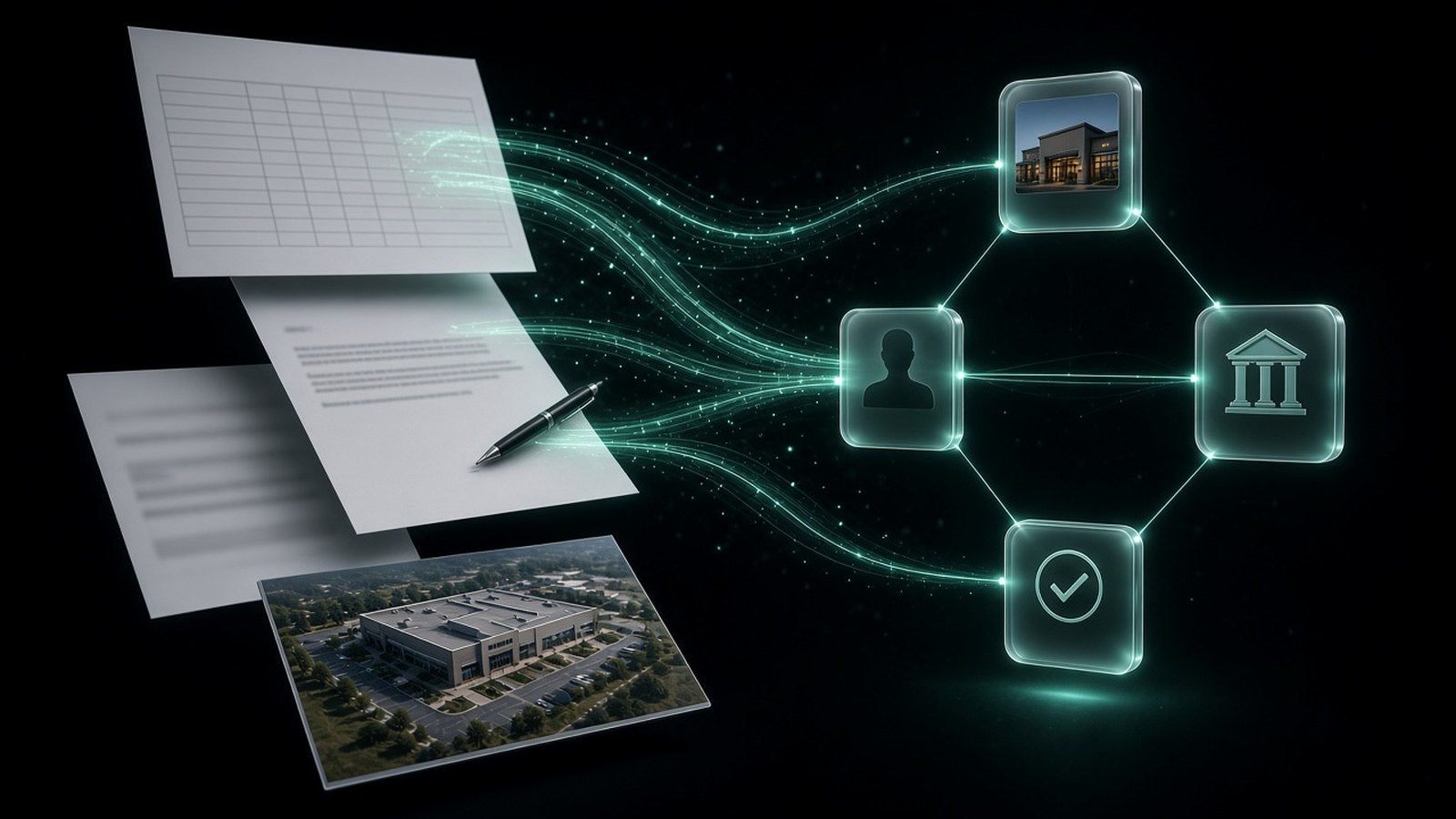
Data is the record: rent rolls, loan balances, a signed lease. Context is what connects the records and explains them. Which deals you passed on, and why. Who made the call, what they assumed, and whether it worked. That the lender on one loan financed two of your other assets and was slow to close last time.
On 27 Oct CoStar agreed to pay about $730M for Vexcel to pull hundreds of data fields per property from aerial imagery. The outside view of a building is becoming something anyone can license. Your reasons can't be licensed.
- Rent roll
- Loan balance
- Signed lease
- Aerial photo of the building
02Without it, a model answers like a smart stranger.
It has read the internet. It knows how firms like yours work in general. It hasn't met yours. Ask it whether to refinance an asset and you get the textbook answer, because the textbook is all it has. Each employee then fills the gap with their own prompt, differently.
With an outside general model, “you can't ensure that that outcome maps to who that company is.”
03It has to keep moving.
A company changes every day. Upload your documents once and the AI has a photograph; by next quarter it's out of date and still confident. Context has to arrive as the work happens: meetings, approvals, deal updates, decisions, and the questions people ask the AI itself. A useful test is lag. How long after a decision is made does your AI know it happened?

A decision is made today. When does your AI know?
Pick the one that's true for your company today.
Hours. Context arrives with the work. Answers stay current.
Days. Answers trail the business. Expect confident, slightly stale advice.
Weeks. The AI is working from an old photograph of the company.
Never. Someone has to tell it everything, every time, in a prompt.
04It starts with the foundation.
Definitions tell an agent what "net revenue" means. They don't tell it what the firm is for. Your purpose, your people and what each one owns, how work moves through the firm, and this year's goals are what let an AI judge whether an answer is good for the company or only for the person asking. Without them, ten people get ten good answers that pull in ten directions.

Is this answer good for the company, or only for the person asking?
05You have to own it.
You'll change models, probably more than once. If what your firm knows lives inside one vendor's assistant, every switch starts from zero, and someone else holds your most valuable asset. Owning it means it lives in your environment, exports with its relationships intact, works with whichever model you choose, and outlasts any employee or tool. Nobody values a building by its power bill. The model is the utility. Your context is the asset.

What to do this quarter
Six moves for your leadership team
Your ticks stay in this browser only.
From the build
At Fort, the order was the lesson. Foundation first, then one source of truth, then models. When ChatGPT arrived, the hard part was already done. As I said on Ep. 353, "because of the foundation we had built, we had a unique distinct advantage to move very quickly." It's the same order I follow today. Next issue, I'll walk through how we built it.
If you switched AI models tomorrow, what would your company lose?
If the honest answer is "most of what it's learned," start there. Reply and tell me what your team said.
Jason
Use this issue with your own AI
Copy as context
One click copies the full issue, its sources and a short set of instructions. Paste it into the AI you already use. It will ask you up to five questions about your firm, then give you a gap assessment against the six moves and a 30-day plan.
See exactly what gets copied
The record
Dated, in my own words.
The case in this issue rests on what I've said and built since 2018. So here are my exact words, each dated and linked to its source, for you to check.
In 2018, after Singularity University, I set out to build a single source of truth for Fort, the system that became Fostr.
- 13 Aug 2019Teaching machine learning what a good deal looks likeEp. 31
Listen · Ep. 31“we have to find a way to identify those in a very systematic way that is repeatable and then we can show it how we did it. And that is the part that becomes proprietary.”
- 23 Aug 2019Preparing for AI, on cameraTechnology at Fort Capital (video)
Watch · Technology at Fort Capital (video)“if we're not preparing for that inevitability, we're just not going to be set up for success the way we could be. And since we know that today, we can go ahead and start taking action and putting things in place like FOS, our own operating system to implement artificial intelligence, machine learning, and get this thing set up so that it is adaptable, agile, and can move in the future”
- 2022 (said 10 Jan 2023)The data pipelines were rebuilt into a warehouse we ownedEp. 258
Listen · Ep. 258“it all lives in a big data warehouse that we built. And so it's our proprietary data system. It's not some offsite thing where we pay somebody to have a storage deal.”
- End of 2022 (said 14 May 2024)The first test of ChatGPT against our own dataEp. 353
Listen · Ep. 353“That version allowed us to go test some things with our data to show very quickly that we're prepared”
- 8 Aug 2023Built so we wouldn't be locked inEp. 300
“really committing to building technology into the company that was gonna set us up to be able to scale and evolve and not lock us in or be beholden to how things work in the future”
Listen · Ep. 300“the things that we put in place four years ago are set up to take advantage of this time.”
- 2023 (said 1 Feb 2024)Our internal AI started with the company, not the dataEp. 334
Listen · Ep. 334“let's start by building the corpus around culture, people, and team. Put our goals, OKRs, and what the people are working on”
- 4 Sep 2025Context that never stops moving, and models as a utilityEp. 392
“what that knowledge graph is, is the context of your business, but not in a static state and a forever state.”
Listen · Ep. 392“models now are becoming a utility and they're improving every day”